1. The Hard Turning Paradigm Shift: Replacing Cylindrical Grinding with Single-Point CNC Precision
In modern high-precision manufacturing, Hard Turning CNC Machines represent a transformative leap in production efficiency, part geometric accuracy, and floor-space utilization. Traditionally, workpieces hardened above 45 Rockwell C (HRC)—such as transmission shafts, hydraulic valves, bearing rings, fuel injectors, and precision mold components—required multi-stage cylindrical grinding operations. Grinding, while capable of micron-level tolerances, introduces substantial capital expenditure, lengthy setup times, hazardous coolant sludge handling, and complex multi-machine workflows.
Hard turning is defined as the single-point single-edge cutting of workpieces having hardness values ranging from 45 HRC to 68+ HRC using Superabrasive Polycrystalline Cubic Boron Nitride (PCBN), Mixed Ceramics (Al2O3 + TiC), or Diamond tools. When performed on high-rigidity CNC turning centers engineered specifically to handle extreme tangential cutting forces, hard turning achieves surface finishes (Ra < 0.2 µm / 8 µin), roundness tolerances (< 1.0 µm), and dimensional repeatability matching or exceeding conventional finish grinding processes.
| Engineering Metric |
Hard Turning CNC Machines |
Cylindrical Grinding Machines |
Operational Impact & ROI Advantage |
| Material Removal Rate (MRR) |
High (Up to 3–4x higher than grinding) |
Low to Moderate (Constrained by wheel loading) |
Cycle time reductions between 50% and 75% per workpiece. |
| Process Flexibility |
Extreme (Complex contours, grooves & threads in 1 setup) |
Low (Requires custom dressed wheels for complex profiles) |
Eliminates specialized wheel profiling tooling costs; reduces machine setup times. |
| Coolant Requirements |
Dry Machining or Minimal Quantity Lubrication (MQL) |
High-volume hazardous water-soluble coolant emulsion |
Eliminates toxic grinding sludge disposal, filtration costs, and worker health risks. |
| Capital & Energy Footprint |
Lower Capital Cost (~40-60% vs. CNC Grinder) |
High Machine Capital & High Energy Consumption |
Dramatically lower floor space requirement and total cost of ownership (TCO). |
| Part Integrity & Residual Stress |
Compressive residual stress profile when optimized |
Risk of thermal burn or tensile stress under improper dress |
Superior fatigue life for critical power-transmission components. |
Global procurement teams evaluating machine tools in today's supply-chain environment must consider not only the initial machine acquisition cost but also operational agility. Hard turning allows machine shops to complete facing, turning, boring, contouring, and thread-cutting on a single CNC turning platform in a single setup, effectively eliminating inter-process buffer inventory and labor-intensive grinding wheel balancing procedures.
2. Structural Engineering Standards for Hard Turning CNC Machines
Performing single-point turning on hardened steels (e.g., 100Cr6, AISI 4340, D2, H13, Case-Hardened Carburized Steels) induces intense localized cutting temperatures (often exceeding 800°C - 1000°C at the tool-chip interface) and massive radial displacement forces. A standard general-purpose CNC lathe will suffer from micro-chatter, accelerated PCBN tool wear, thermal drift, and unacceptable dimensional degradation under hard turning conditions. Purpose-built hard turning CNC machines require specific engineering features:
A. Ultra-Rigid Base Construction & Vibration Damping
Vibration is the primary catalyst for premature PCBN insert micro-chipping. Premium hard turning machines utilize heavy mineral cast beds (polymer concrete) or heavily ribbed meehanite cast iron bases with damping capacities up to 6 to 10 times higher than fabricated steel weldments. Dampening the dynamic energy created during chip formation is vital for maintaining subsurface metallurgy free of white layer formations.
B. Hydrostatic or Heavy Duty Roller Guideways
Guideway selection dictates dynamic stiffness. Hydrostatic guide systems supply a continuous oil film between sliding surfaces, providing infinite fatigue life and complete stick-slip elimination during micro-stepping adjustments. Alternatively, wide-frame preloaded box ways or ultra-heavy roller linear guideways ensure maximum load capacity under continuous heavy radial push forces.
C. Thermal Stability & Active Compensation
Because hard turning generates concentrated heat in the tool tip and spindle nose, real-time thermal drift mitigation is imperative. Top-tier CNC turning centers employ liquid-cooled high-torque motorized spindles, symmetric bed structures, and direct-absolute optical linear scales on all linear axes (X and Z) with sub-micron feedback resolution (0.01 µm).
Technical Knowledge Highlight: Metallurgical Impact of Hard Turning
When hard turning on properly engineered equipment, the intense shear zone heat softens the localized chip material just prior to separation—a process known as thermally assisted shear localization. This micro-phenomenon enables smooth cutting of 62 HRC steel provided the machine tool has sufficient static rigidity to prevent tool deflection.
3. Featured Hard Turning CNC Machines & Precision Solutions
WSM Technology brings over four decades of technical machinery expertise to North American manufacturers, offering premier global turning brands tailored for high-hardness applications. Below are two industry-leading machine lineups engineered for hard turning excellence:
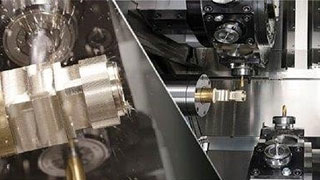
Schaublin High Precision CNC Turning Centers
Hailing from Switzerland's precision watchmaking and micromechanics corridor, Schaublin Machines SA represents the absolute pinnacle of ultra-precision hard turning. Featuring hand-scraped guide beds, hydrostatic headstocks, and integrated ultra-precise spindles, Schaublin lathes routinely hold sub-micron tolerances on hardened components.
Target Hardness: Up to 68 HRC
Spindle Accuracy: Runout < 0.5 µm
Applications: Aerospace fuel systems, medical implants, micro-bearings
Inquire Now
ROMI Heavy-Duty Turning Centers & CNC Lathes
Engineered with massive monoblock cast iron bases and high-torque direct-drive spindles, ROMI CNC Turning Centers deliver the raw structural mass and rigidity required for heavy-duty hard turning of large diameter shafts, gear blanks, and heavy industrial machinery bushings.
Target Hardness: 45 to 62 HRC
Bed Structure: Heavy-ribbed Monoblock Cast Iron
Applications: Automotive drive shafts, heavy gear manufacturing, oil & gas valves
Inquire Now
4. Global Procurement & Technological Trends in Hard Turning (2025–2030)
As global supply chains demand higher throughput, lower carbon footprints, and complete trace-ability, machine tool procurement directors are prioritizing advanced turning technologies. Key developments shaping the future of hard turning CNC machines include:
1. Integration of AI-Driven Adaptive Feed & Tool Condition Monitoring
Hard turning operations are sensitive to micro-variations in workpiece hardness (e.g., hard spots in carburized layers) and tool wear. Next-generation hard turning centers incorporate acoustic emission sensors and high-speed motor current feedback loops. AI algorithms automatically adjust feed rates in real-time to prevent catastrophic PCBN tool failure, extending tool life by up to 35%.
2. Hybrid Turning-Grinding Machine Architectures
For ultra-critical components requiring both rapid material removal and specific non-directional surface textures (such as lip seal journals), hybrid CNC turning platforms combining a heavy hard turning spindle and an auxiliary high-speed internal/external grinding spindle on a single bed are becoming the new industry standard.
3. Sustainable Dry Machining & MQL Systems
Escalating environmental regulations across Europe and North America are forcing shops to eliminate flood coolants. Hard turning naturally operates dry because heat is concentrated within the continuous chip. The adoption of Minimal Quantity Lubrication (MQL) with targeted cold-air nozzles is expanding hard turning into previously challenging interrupted-cut geometries.
4. Micro-Hard Turning for Medical & Micro-Fluidic Valves
With sub-micron servo resolutions and direct-drive torque motors, micro-hard turning is replacing wire EDM and micro-grinding for tiny hardened steel pins, surgical tools, and miniature aerospace servo valves, reducing cycle times from minutes to seconds.
5. Why Partner with WSM Technology for Your Hard Turning Requirements?
Acquiring a hard turning CNC machine requires more than choosing machine specifications from a catalogue; it demands deep process knowledge, custom tooling application engineering, and local field support. WSM Technology Inc. brings unmatched expertise to manufacturers across Northern Ohio, Western Pennsylvania, West Virginia, and surrounding regions.
- Over 40 Years of Application Knowledge: Founded under the leadership of President Blaise Buholzer—an industry expert with decades of EDM and high-precision CNC experience—WSM Technology brings practical shop-floor insight to every customer challenge.
- Rootstown Demonstration Center: Located in Rootstown, Ohio, our state-of-the-art facility features live demo machines where manufacturers can run comparative test cuts, perform time studies, and validate tool life on their exact hardened workpieces prior to investment.
- World-Class Brand Portfolio: As authorized partners for world-renowned machine tool builders—including Schaublin, ROMI, MC Machinery / Mitsubishi Electric, OPS Ingersoll, Roku-Roku, Titan, Sarix, and Cheto—we provide complete manufacturing solutions spanning milling, EDM, and precision turning.
- Turnkey Applications & Training: We provide full operator training, specialized PCBN tooling selection, workholding integration (diaphragm chucks, pitch-line chucks), and lifetime technical support.

Blaise Buholzer
President & Founder, WSM Technology Inc.
"Hard turning requires absolute synergy between machine structural rigidity, thermal equilibrium, and cutting tool geometry. Our core goal at WSM Technology is to walk alongside metalworking shops, proving out processes in our test cut lab to guarantee immediate productivity and long-term profitability."
6. Hard Turning CNC Machines: Frequently Asked Questions (FAQ)
Below are authoritative answers to the most frequently asked technical and procurement questions regarding Hard Turning CNC Machines submitted by global manufacturing engineers and procurement heads.
What is the hardness threshold for Hard Turning CNC Machines?
Hard turning typically applies to materials hardened between 45 HRC and 68 HRC. Common alloys include case-hardened alloy steel (e.g., 8620, 5120), through-hardened bearing steels (100Cr6 / 52100), tool steels (D2, A2, H13), and high-temperature nickel-base superalloys in their aged hardened state.
Can hard turning achieve the surface finish quality of cylindrical grinding?
Yes. On a properly engineered hard turning CNC machine equipped with high-rigidity spindles and appropriate PCBN wiper inserts, achievable surface finishes range from Ra 0.15 µm to 0.4 µm (6–16 micro-inches), which satisfies the requirements for most bearing journals, seal surfaces, and automotive transmission components.
What is "White Layer" in hard turning, and how can it be avoided?
White layer is a microscopic, hard, brittle re-hardened martensitic layer formed on the workpiece surface due to excessive friction and thermal buildup from worn tools. It is avoided by maintaining machine rigidity, avoiding micro-chatter, utilizing sharp PCBN inserts with optimized edge hones, and replacing inserts before flank wear exceeds 0.2 mm.
How do PCBN inserts compare to ceramic inserts for hard turning?
PCBN (Polycrystalline Cubic Boron Nitride) inserts offer far superior toughness, thermal conductivity, and wear resistance compared to ceramics, making them the industry choice for hardened steels above 55 HRC and for interrupted cuts. Ceramics are more cost-effective for continuous light finishing cuts on materials between 45–55 HRC.
Why is dry machining preferred over flood coolant in hard turning?
Applying cold flood coolant intermittently to a PCBN insert cutting at 800°C induces severe thermal shock, causing micro-cracking and premature tool destruction. Dry turning keeps the tool temperature consistently elevated, allowing thermal softening of the shear zone material while saving coolant disposal costs.
What machine workholding is recommended for precision hard turning?
High-precision diaphragm chucks, pitch-line pin chucks (for gears), and specialized collet systems with low clamping distortion are recommended. Because hard turning cuts near finished dimensions, workholding concentricity must routinely be within 0.002 mm (0.00008 inches).
How does hard turning impact tool room lead times?
Hard turning eliminates the queue time and handling needed to transfer heat-treated parts to a grinding department. Parts go directly from heat treatment to the CNC hard turning center, reducing overall manufacturing lead times by up to 80%.
Can WSM Technology conduct test cuts on our hardened parts before purchasing?
Absolutely. At our Rootstown, Ohio demonstration facility, WSM Technology routinely conducts comprehensive time studies, tool wear evaluations, and surface finish tests using your actual production parts and CAD drawings.
7. Ready to Upgrade Your Hard Machining Capabilities?
Transitioning from grinding to hard turning or upgrading your existing CNC lathe capacity is a strategic decision that delivers immediate bottom-line dividends. Contact the engineering team at WSM Technology today to discuss your part drawings, material specifications, and tolerance goals.